


Table of Contents
- Introduction
- What Is the Dave Ramsey Investment Calculator?
- How Does the Dave Ramsey Investment Calculator Work?
- Key Inputs You Need Before Using the Calculator
- Understanding the Results Without Misinterpreting Them
- Benefits of Using the Dave Ramsey Investment Calculator
- Limitations You Should Know Before Making Financial Decisions
- Strategies to Improve Your Investment Results
- Dave Ramsey Investment Calculator Example
- Common Mistakes People Make When Using Investment Calculators
- Frequently Asked Questions (FAQs)
- Final Thoughts
Dave Ramsey Investment Calculator: A Practical Guide to Estimating Your Future Wealth
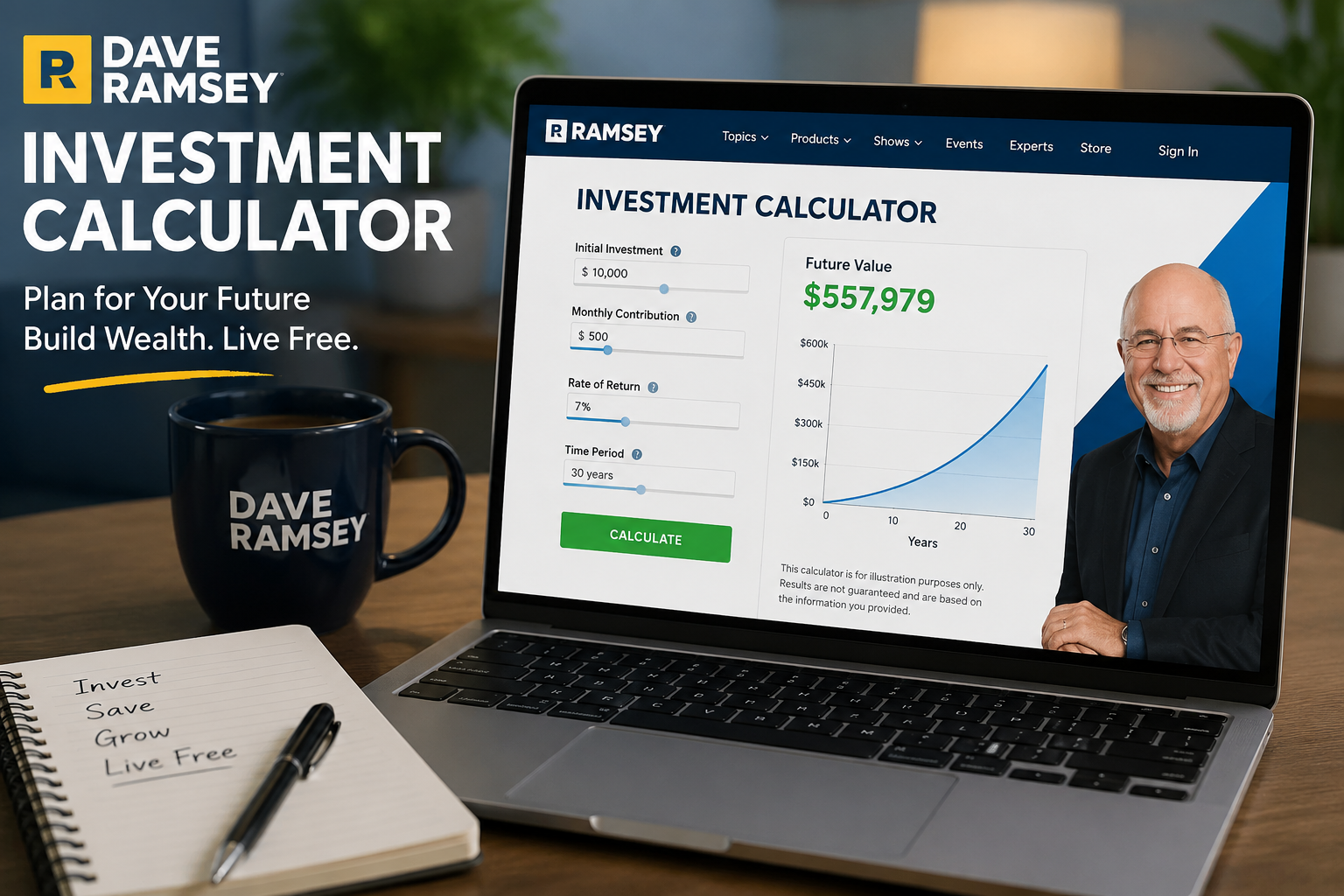
Dave Ramsey investment calculator: Planning for retirement or long-term financial goals can feel overwhelming, especially if you’re unsure how much money you’ll actually have in the future. This is where the Dave Ramsey Investment Calculator becomes a valuable tool. Instead of making random guesses, it allows you to estimate how your investments could grow over time based on your monthly contributions, expected rate of return, and investment period.
One of the reasons this calculator has become so popular is its simplicity. You don’t need to be a financial expert to understand how it works. Whether you’re investing for retirement, building wealth, or saving for your children’s education, the calculator provides a realistic estimate that helps you stay motivated and focused on your financial goals.
In this guide, you’ll learn how the Dave Ramsey Investment Calculator works, what information you need before using it, how to interpret the results correctly, and the smartest ways to maximize your investment growth. By the end of this article, you’ll have a much clearer understanding of how small, consistent investments can potentially grow into significant wealth over the years.
What Is the Dave Ramsey Investment Calculator?
The Dave Ramsey Investment Calculator is an online financial planning tool designed to estimate how much your investments may be worth in the future. It uses compound interest calculations to project the growth of your money over time. Instead of promising exact returns, it provides an estimate based on the information you enter, making it easier to visualize your long-term financial progress.
The calculator generally asks for a few simple details, including your starting investment amount, monthly contribution, expected annual return, and the number of years you plan to invest. Once these values are entered, it quickly estimates your future investment balance, helping you understand the impact of consistent investing and compound growth.
One of the biggest reasons people like this calculator is that it encourages long-term thinking. Rather than focusing on short-term market fluctuations, it highlights the importance of staying invested for decades. This aligns with Dave Ramsey’s overall financial philosophy, which emphasizes patience, discipline, and consistent investing instead of trying to time the stock market.
How Does the Dave Ramsey Investment Calculator Work?
At its core, the calculator uses the principle of compound interest. Compound interest means your investment earns returns, and then those returns also begin earning additional returns over time. As the years pass, this compounding effect can significantly increase your overall investment value.
The calculator combines your initial investment with your regular monthly contributions and applies an assumed annual rate of return. It repeats this process for every year you choose, showing how your portfolio may grow if your investments perform according to the estimated return. Although the actual stock market rarely delivers the exact same return every year, the calculator provides a useful long-term projection.
Another important aspect is consistency. Even if your monthly investment amount seems small today, investing regularly for twenty or thirty years can produce impressive results because every contribution has time to grow. The calculator helps demonstrate that time in the market is often more important than trying to invest large amounts all at once.
Key Inputs You Need Before Using the Calculator
Before using the calculator, you’ll need to know your starting investment balance. This could be the money already sitting in your retirement account, brokerage account, or another investment portfolio. If you’re just beginning, you can simply enter zero and focus on future contributions.
The second major input is your monthly investment amount. This is the amount you plan to invest consistently each month. Even modest contributions like $100, $300, or $500 per month can grow substantially over several decades, especially when combined with compound interest.
You’ll also need to choose an estimated annual rate of return and your investment timeline. Many people use historical stock market averages as a reference, although future performance is never guaranteed. Your investment period is equally important because longer timelines generally allow your investments more opportunities to recover from market downturns and continue growing. dave ramsey investment calculator
Understanding the Results Without Misinterpreting Them
When the calculator displays your estimated future investment value, it’s important to remember that the result is only a projection. Financial markets naturally rise and fall over time, so actual investment returns may be higher or lower than the estimate shown.
Many beginners mistakenly assume the projected balance is guaranteed. In reality, investment calculators use mathematical assumptions rather than market predictions. The purpose is to help you understand potential outcomes under consistent investing conditions, not to promise future wealth.
It’s also helpful to compare different scenarios. Try increasing your monthly contribution, extending your investment timeline, or using a slightly different rate of return. These comparisons show how small changes today can dramatically affect your future financial position and may encourage better saving habits.
Benefits of Using the Dave Ramsey Investment Calculator
One major advantage of the calculator is that it helps you set realistic financial goals. Instead of saving without direction, you can estimate how much you need to invest each month to reach your retirement or wealth-building objectives.
The calculator also provides motivation. Watching projected balances increase over time often encourages people to continue investing, even during periods when the market experiences temporary declines. It reinforces the idea that consistency often matters more than perfection.
Another benefit is financial awareness. Many people underestimate the power of compound interest until they actually see the numbers. The calculator transforms abstract financial concepts into understandable projections, making it easier to appreciate the long-term benefits of disciplined investing. dave ramsey investment calculator
Limitations You Should Know Before Making Financial Decisions
Although the calculator is useful, it has limitations. It assumes a constant annual rate of return, while actual investment performance changes every year. Some years may produce strong gains, while others may experience losses.
Inflation is another factor that can reduce purchasing power over time. Even if your investment account grows significantly, future living costs may also increase. It’s important to consider inflation when planning for retirement or other long-term goals.
Taxes, investment fees, and changes in contribution amounts are also difficult to predict accurately. These factors can influence your final investment balance. Therefore, the calculator should be viewed as a planning tool rather than an exact financial forecast.
Strategies to Improve Your Investment Results
Increasing your monthly investment is one of the easiest ways to improve long-term growth. Even adding an extra $50 or $100 each month can result in thousands of additional dollars over several decades due to compound interest.
Starting early is equally important. Someone who begins investing in their twenties generally has a significant advantage over someone who waits until their forties, even if both invest the same monthly amount. Time allows compound growth to work much more effectively.
Remaining invested during market downturns is another key strategy. Many investors panic during market declines and sell their investments, locking in losses. Long-term investing usually rewards patience, and history has shown that markets have generally recovered over extended periods.
Diversification also plays an important role. Investing across different industries, sectors, and asset classes can reduce overall risk while providing opportunities for long-term growth. A balanced portfolio is generally more resilient than concentrating investments in a single company or sector. dave ramsey investment calculator
Dave Ramsey Investment Calculator Example
Imagine Sarah is 30 years old and already has $15,000 invested. She plans to invest an additional $500 every month until she turns 65. Assuming an average annual return of 10%, the investment calculator projects substantial long-term growth thanks to consistent contributions and compound interest.
Now consider John, who waits until age 40 before making the same monthly investment. Even though he contributes the same amount every month, his investments have ten fewer years to grow. As a result, his estimated final portfolio is considerably smaller than Sarah’s.
This example illustrates one of the most valuable lessons in investing: starting earlier often has a greater impact than investing larger amounts later. Time is one of the most powerful tools available to long-term investors.
Common Mistakes People Make When Using Investment Calculators
One common mistake is expecting guaranteed returns. Investment calculators rely on assumptions rather than promises. Markets are unpredictable, and actual performance will naturally vary over time.
Another mistake is choosing unrealistic annual return estimates. Selecting excessively high returns can create overly optimistic expectations that may not reflect real-world investing. Conservative assumptions often produce more practical financial plans.
Many people also ignore inflation and investment costs when reviewing projections. While calculators provide useful estimates, smart investors consider additional real-world factors such as taxes, fund expenses, inflation, and unexpected life events before making major financial decisions.
Finally, some users focus only on the final balance instead of the investing process itself. Building wealth is usually the result of consistent monthly contributions, patience, and disciplined financial habits rather than chasing quick gains. dave ramsey investment calculator
Frequently Asked Questions (FAQs)
Is the Dave Ramsey Investment Calculator free to use?
Yes. The calculator is generally available online at no cost and can be used by anyone who wants to estimate future investment growth.
Is the calculator accurate?
The calculations are mathematically accurate based on the information you enter. However, actual investment returns can differ because financial markets fluctuate over time.
What annual return should I use?
Many investors use historical stock market averages as a reference, but it’s wise to use realistic assumptions and remember that future returns are never guaranteed.
Can beginners use this calculator?
Absolutely. The calculator is designed to be simple and user-friendly, making it suitable for both beginners and experienced investors.
Does the calculator include inflation?
Most basic investment calculators do not automatically adjust for inflation. You should consider inflation separately when planning long-term financial goals.
Can I use it for retirement planning?
Yes. Many people use the calculator to estimate retirement savings, although it’s also useful for education funds, financial independence goals, and other long-term investment plans.
Should I rely only on this calculator?
No. While it is an excellent planning tool, it should be combined with a broader financial strategy that considers taxes, investment fees, risk tolerance, diversification, and professional advice when appropriate.
Final Thoughts
The Dave Ramsey Investment Calculator is an excellent starting point for anyone who wants to understand how consistent investing can build long-term wealth. By combining regular monthly contributions with the power of compound interest, it demonstrates that even modest investments can grow into substantial financial assets over time.
While no calculator can predict the future with complete accuracy, this tool provides valuable insight into how different saving habits and investment timelines may influence your financial future. It encourages disciplined investing rather than emotional decision-making and helps users stay focused on long-term goals.
Ultimately, the biggest lesson isn’t the exact number the calculator produces—it’s the importance of starting early, investing consistently, remaining patient during market fluctuations, and allowing compound growth to work over decades. Whether you’re saving for retirement, financial independence, or another major life goal, using the Dave Ramsey Investment Calculator can help you make more informed decisions and build greater confidence in your financial journey.
You May Also Read:
Vladimir Duthiers Salary: Estimated Earnings, Career Growth, and CBS News Success


