


Table of Contents
- What Is Startup Booted Financial Modeling?
- Why Financial Modeling Matters for Bootstrapped Startups
- The Core Components of a Startup Financial Model
- Revenue Forecasting for Bootstrapped Businesses
- Estimating Startup Expenses the Right Way
- Managing Cash Flow Without Investor Funding
- Common Financial Modeling Mistakes to Avoid
- Best Tools for Startup Booted Financial Modeling
- Frequently Asked Questions
- Conclusion
What Is Startup Booted Financial Modeling?
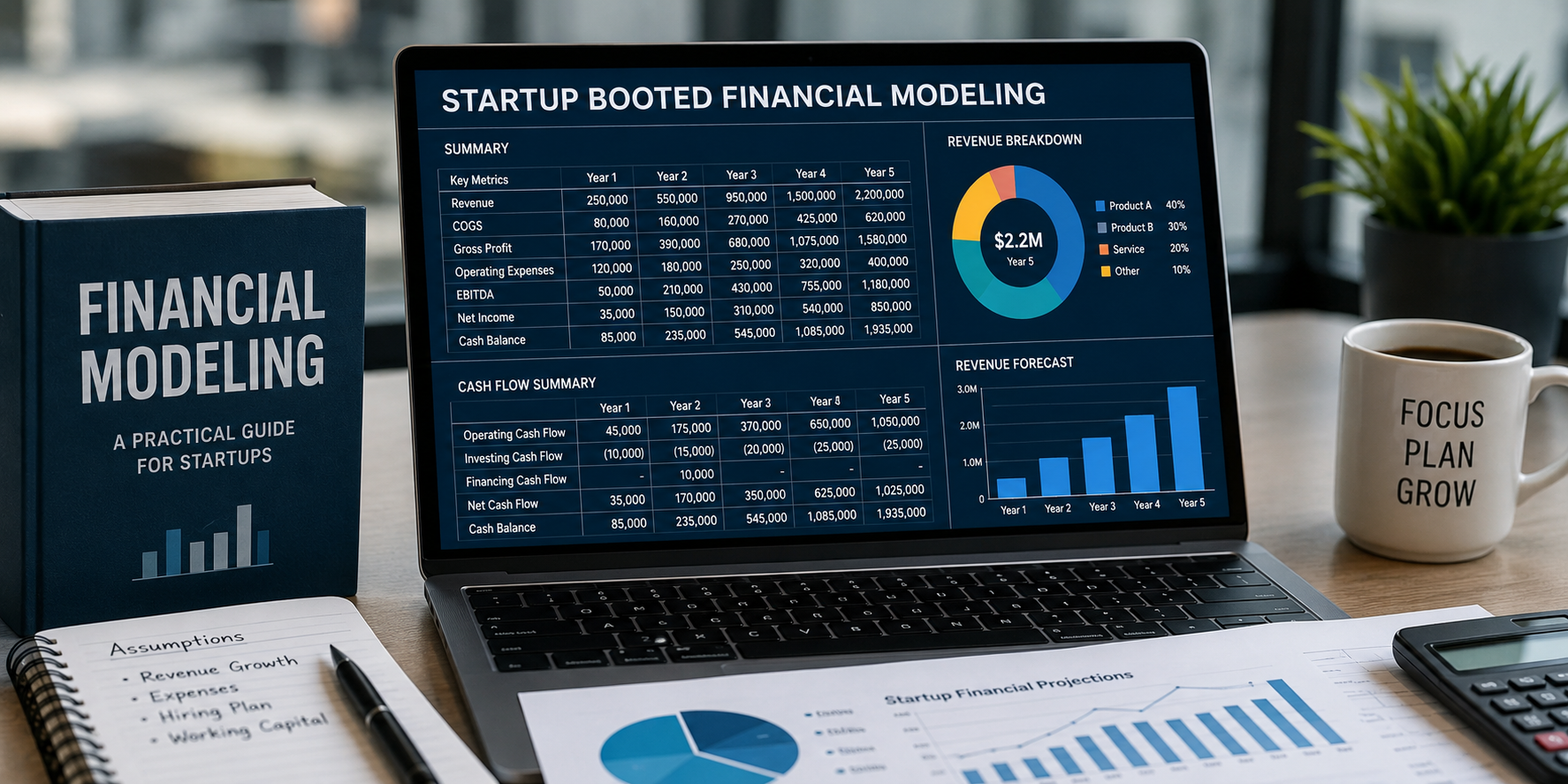
Startup booted financial modeling: Starting a business without investors is becoming more common than ever. Many entrepreneurs prefer to build companies using their own savings, early customer revenue, and smart financial decisions instead of giving away equity. This approach is known as bootstrapping, and one of its biggest success factors is having a solid financial model. Startup booted financial modeling is the process of creating financial forecasts and plans that help a self-funded startup survive, grow, and stay profitable.
Unlike venture-backed startups that may have millions of dollars available for rapid expansion, bootstrapped businesses operate with limited resources. Every dollar matters, every expense needs a purpose, and every financial decision has a direct impact on the company’s future. A good financial model allows founders to understand where money is coming from, where it is going, and how long the business can continue operating under different scenarios.
Financial modeling is not just about creating spreadsheets filled with numbers. It is about understanding the financial health of your company before problems appear. A realistic model helps founders make better hiring decisions, set achievable revenue goals, prepare for slow months, and identify opportunities for growth while reducing unnecessary financial risks.
Why Financial Modeling Matters for Bootstrapped Startups
Many first-time founders believe financial modeling is only necessary when raising investment. In reality, bootstrapped startups often need financial planning even more because they don’t have outside funding to rescue them if cash runs out. A detailed model acts like a roadmap that guides business decisions based on real data instead of assumptions.
One of the biggest advantages of startup booted financial modeling is improved cash management. Cash flow problems are among the leading reasons startups fail, even when they have a great product or service. By forecasting income and expenses months in advance, founders can identify periods where cash may become tight and take corrective action before the situation becomes critical.
Financial models also improve confidence when making strategic decisions. Whether you’re planning to launch a new product, hire employees, increase marketing spending, or expand into another market, your financial model can estimate the possible outcomes. Instead of guessing, you can compare multiple scenarios and choose the option that offers the best balance between growth and financial stability.
Another benefit is accountability. Once financial targets are documented, founders can compare actual performance against projected numbers every month. If revenue is lower than expected or expenses begin increasing too quickly, adjustments can be made immediately instead of discovering problems at the end of the year. startup booted financial modeling
The Core Components of a Startup Financial Model
A financial model should be simple enough to maintain but detailed enough to provide useful insights. Many successful bootstrapped founders begin with a straightforward model and improve it as their businesses grow. The goal is not complexity—it is clarity.
The first component is the revenue forecast. This estimates how much money the business expects to earn over a specific period. Revenue projections should be based on realistic assumptions such as expected customer growth, average purchase value, pricing strategy, subscription renewals, and seasonal demand. Avoid unrealistic growth rates that cannot be supported by actual business performance. Startup booted financial modeling

The second component is the expense forecast. Every business has both fixed and variable costs. Fixed costs include rent, salaries, software subscriptions, insurance, and hosting fees. Variable costs include advertising, shipping, payment processing fees, commissions, and manufacturing expenses. Separating these costs helps founders understand where money is being spent and identify opportunities to improve efficiency.
The third essential component is cash flow forecasting. While revenue shows how much money you earn, cash flow reveals when money actually enters and leaves your business. A company may appear profitable on paper but still struggle if customer payments arrive too slowly. Tracking monthly cash flow helps ensure there is enough money available to cover operating expenses throughout the year.
Many financial models also include projected profit and loss statements, balance sheets, and key performance indicators such as gross margin, operating margin, customer acquisition cost, lifetime customer value, monthly recurring revenue, and break-even analysis. These metrics provide a complete picture of business performance.
Revenue Forecasting for Bootstrapped Businesses
Revenue forecasting is often the most challenging part of startup booted financial modeling because no one can predict the future with complete accuracy. However, the objective isn’t to predict exact numbers. Instead, the goal is to create reasonable estimates based on available information and update them regularly as new data becomes available.
A practical starting point is understanding your target audience and expected customer growth. Estimate how many customers you can realistically acquire each month through your existing marketing channels. If your website currently attracts 5,000 visitors each month and converts 2% into paying customers, your revenue projections should reflect those actual conversion rates rather than unrealistic expectations. startup booted financial modeling
Pricing strategy also plays an important role. Small pricing adjustments can significantly affect long-term revenue. For example, increasing subscription prices by a small percentage while maintaining customer satisfaction may generate more profit than simply trying to acquire thousands of new customers. Your financial model should allow you to test different pricing scenarios before making changes.
Founders should also account for seasonality. Many businesses experience stronger sales during holidays, year-end periods, or industry-specific buying seasons. Ignoring these fluctuations can produce inaccurate forecasts that make financial planning more difficult. Historical sales data becomes increasingly valuable as the business grows because it helps identify recurring patterns.
Another useful technique is scenario planning. Instead of relying on a single forecast, create three different models. A conservative scenario assumes slower growth, an expected scenario represents realistic performance, and an optimistic scenario reflects faster expansion. Comparing these possibilities helps founders prepare for uncertainty without making risky financial commitments. startup booted financial modeling
Estimating Startup Expenses the Right Way
One of the biggest mistakes bootstrapped founders make is underestimating expenses. While it’s natural to focus on revenue growth, keeping costs under control is equally important. A well-built startup booted financial modeling plan should include every expected expense, no matter how small it seems. Small recurring costs can add up quickly over time.
Start by listing all fixed monthly expenses. These include website hosting, domain renewals, software subscriptions, internet bills, salaries, office rent (if applicable), accounting services, insurance, and any loan repayments. Since these costs remain relatively stable, they form the foundation of your monthly budget and are easier to forecast.
Next, estimate variable expenses that change depending on business activity. Marketing campaigns, payment gateway fees, shipping charges, freelance work, customer support costs, and inventory purchases all fall into this category. Variable costs often increase as revenue grows, so your financial model should account for that relationship rather than assuming expenses remain constant.
Don’t forget one-time expenses either. Purchasing equipment, redesigning a website, developing a mobile application, attending industry conferences, or hiring consultants can significantly affect cash flow during certain months. Including these planned investments helps avoid financial surprises and ensures your business maintains enough reserves to continue operating smoothly.
Another smart practice is adding a contingency budget. Unexpected expenses happen in every business, whether it’s replacing equipment, handling legal paperwork, or responding to sudden market changes. Setting aside even 5–10% of your projected expenses can provide valuable financial protection. startup booted financial modeling
Managing Cash Flow Without Investor Funding
Cash flow management is the heart of every successful bootstrapped startup. Unlike venture-funded companies, self-funded businesses cannot rely on investors to inject more capital whenever money becomes tight. That makes positive cash flow one of the most important financial goals.
The first strategy is collecting revenue as quickly as possible. If your business offers services, consider requesting partial payments upfront or shortening invoice payment terms. Subscription-based businesses benefit from annual payment options because they receive cash immediately instead of waiting for monthly installments.
Controlling expenses is equally important. Before making any purchase, ask whether it directly contributes to revenue growth or operational efficiency. Many startups waste money on expensive software, premium office space, or unnecessary tools before reaching consistent profitability. Staying lean allows your business to survive longer while building a stronger financial foundation.
Maintaining a cash reserve is another essential habit. Even profitable companies experience slow months, delayed customer payments, or unexpected emergencies. Ideally, a bootstrapped startup should aim to keep several months of operating expenses available in reserve. This financial cushion provides flexibility during uncertain periods and reduces unnecessary stress. startup booted financial modeling
Monitoring cash flow weekly instead of monthly can also make a significant difference. Weekly reviews help founders identify potential issues early, adjust spending, and react faster to changing business conditions. Small problems are much easier to fix before they become major financial challenges.
Common Financial Modeling Mistakes to Avoid
Even experienced entrepreneurs make mistakes when creating financial models. The good news is that most of these mistakes can be avoided with realistic planning and regular updates.
One common mistake is being overly optimistic about revenue growth. Many founders expect sales to increase rapidly without considering customer acquisition costs, competition, or market demand. While optimism is important in entrepreneurship, financial models should remain grounded in realistic assumptions backed by available data.
Another frequent error is ignoring operating expenses. Businesses often focus on product development while forgetting recurring costs like software subscriptions, taxes, customer support, maintenance, and administrative expenses. These seemingly minor costs can gradually reduce profitability if they are not included in the model. startup booted financial modeling
Some founders create a financial model once and never update it again. A financial model should evolve alongside the business. Monthly reviews allow you to compare actual results with projections, adjust assumptions, and improve forecasting accuracy over time. A living financial model is far more valuable than one that sits untouched in a folder. startup booted financial modeling
Many startups also fail to prepare for unexpected situations. Markets change, customer behavior shifts, suppliers increase prices, and economic conditions fluctuate. Including multiple financial scenarios—best case, expected case, and worst case—helps businesses stay prepared for uncertainty while making better strategic decisions.
Finally, avoid making your financial model unnecessarily complicated. Hundreds of formulas and dozens of worksheets may look impressive, but they often become difficult to maintain. Simplicity makes financial models easier to understand, update, and use for everyday decision-making.
Best Tools for Startup Booted Financial Modeling
Today, founders have access to many tools that simplify financial planning without requiring advanced accounting knowledge. The right tool depends on your business size, budget, and reporting needs. startup booted financial modeling
Microsoft Excel remains one of the most popular choices because of its flexibility. Founders can build customized financial models, create forecasting formulas, perform scenario analysis, and generate charts that visualize business performance. Although it requires some spreadsheet skills, Excel is powerful enough for businesses of nearly every size.
Google Sheets is another excellent option, especially for startups with remote teams. Since it’s cloud-based, multiple team members can collaborate in real time, making it easy to update budgets, forecasts, and financial reports from anywhere. Automatic saving and version history are additional advantages.
Accounting platforms such as QuickBooks and Xero can integrate directly with your bank accounts and automatically track income and expenses. These tools reduce manual data entry and provide accurate financial reports that support better forecasting. They are particularly useful once your business begins handling a larger number of transactions.
Specialized financial planning platforms are also available for startups that require advanced forecasting, investor reporting, and scenario modeling. However, many early-stage bootstrapped businesses find that spreadsheets combined with reliable accounting software provide everything needed during the initial growth phase.
Regardless of which tool you choose, consistency matters more than complexity. Updating your financial model regularly and reviewing key metrics every month will provide far greater value than using expensive software without maintaining accurate data. startup booted financial modeling
Frequently Asked Questions (FAQs)
1. What is startup booted financial modeling?
Startup booted financial modeling is the process of creating financial forecasts, budgets, and cash flow projections for businesses that are funded primarily through founder savings and business revenue instead of outside investment.
2. Why is financial modeling important for bootstrapped startups?
It helps founders manage cash flow, estimate expenses, forecast revenue, reduce financial risk, and make informed business decisions without relying on investor funding.
3. How often should I update my financial model?
Most experts recommend reviewing and updating your financial model every month. Businesses experiencing rapid growth may benefit from weekly updates to maintain accurate forecasts.
4. What should be included in a startup financial model?
A complete model typically includes revenue forecasts, operating expenses, cash flow statements, profit and loss projections, balance sheet estimates, break-even analysis, and key performance indicators (KPIs).
5. Can a simple spreadsheet be enough?
Yes. Many successful bootstrapped startups begin with Microsoft Excel or Google Sheets. As the business grows, more advanced financial planning software can be adopted if necessary.
6. What’s the biggest mistake founders make?
The most common mistake is overestimating revenue while underestimating expenses. Realistic assumptions create more reliable financial models and lead to better business decisions. startup booted financial modeling
Conclusion
Startup booted financial modeling is much more than a budgeting exercise—it is a decision-making framework that helps entrepreneurs build strong, sustainable businesses without depending on outside investors. By forecasting revenue realistically, tracking expenses carefully, monitoring cash flow consistently, and reviewing financial performance on a regular basis, founders can reduce uncertainty and make smarter strategic choices.
A successful bootstrapped startup is rarely built on luck alone. It grows through disciplined financial planning, careful spending, and continuous improvement. Your financial model serves as the roadmap that guides every major business decision, from hiring employees and launching products to expanding into new markets. startup booted financial modeling
Whether you’re starting your first business or scaling an existing one, investing time in creating and maintaining a reliable startup booted financial modeling system will give you greater confidence, stronger financial control, and a much better chance of achieving long-term success. Remember that no forecast will ever be perfect, but a thoughtful and regularly updated financial model is one of the most valuable tools any entrepreneur can have. startup booted financial modeling
You May Also Read:
Tech eTrueSports: How Technology Is Transforming Modern Esports
BackToFrontShow Pricing: Complete Guide to Plans, Features, Costs & Value in 2026


