


Table of Contents
- Introduction to Assault Bikes
- What Is an Assault Bike?
- Top Benefits of Using an Assault Bike
- How to Use an Assault Bike Properly
- Best Assault Bike Workouts for Beginners and Advanced Users
- How to Choose the Best Assault Bike
- Common Mistakes to Avoid
- Is an Assault Bike Worth Buying?
- Frequently Asked Questions (FAQs)
- Final Thoughts
Introduction to Assault Bikes
If you’ve ever stepped into a commercial gym or watched athletes train for high-intensity competitions, you’ve probably seen an assault bike sitting in the corner. At first glance, it may look like a regular exercise bike with moving handlebars, but don’t let its appearance fool you. This machine is one of the toughest pieces of cardio equipment you can use, and that’s exactly why fitness enthusiasts love it.
Unlike traditional stationary bikes that mainly target your lower body, an assault bike engages both your upper and lower body at the same time. The harder you push and pedal, the greater the resistance becomes. This unique air-resistance system means there are no fixed difficulty levels. Your effort determines the intensity, making every workout as easy or as brutal as you choose.
Whether your goal is weight loss, improved endurance, muscle conditioning, or athletic performance, an assault bike offers one of the most effective full-body workouts available. In this guide, we’ll cover everything you need to know—from how it works to workout ideas and buying tips—so you can decide if it’s the right fitness investment for you.
What Is an Assault Bike?
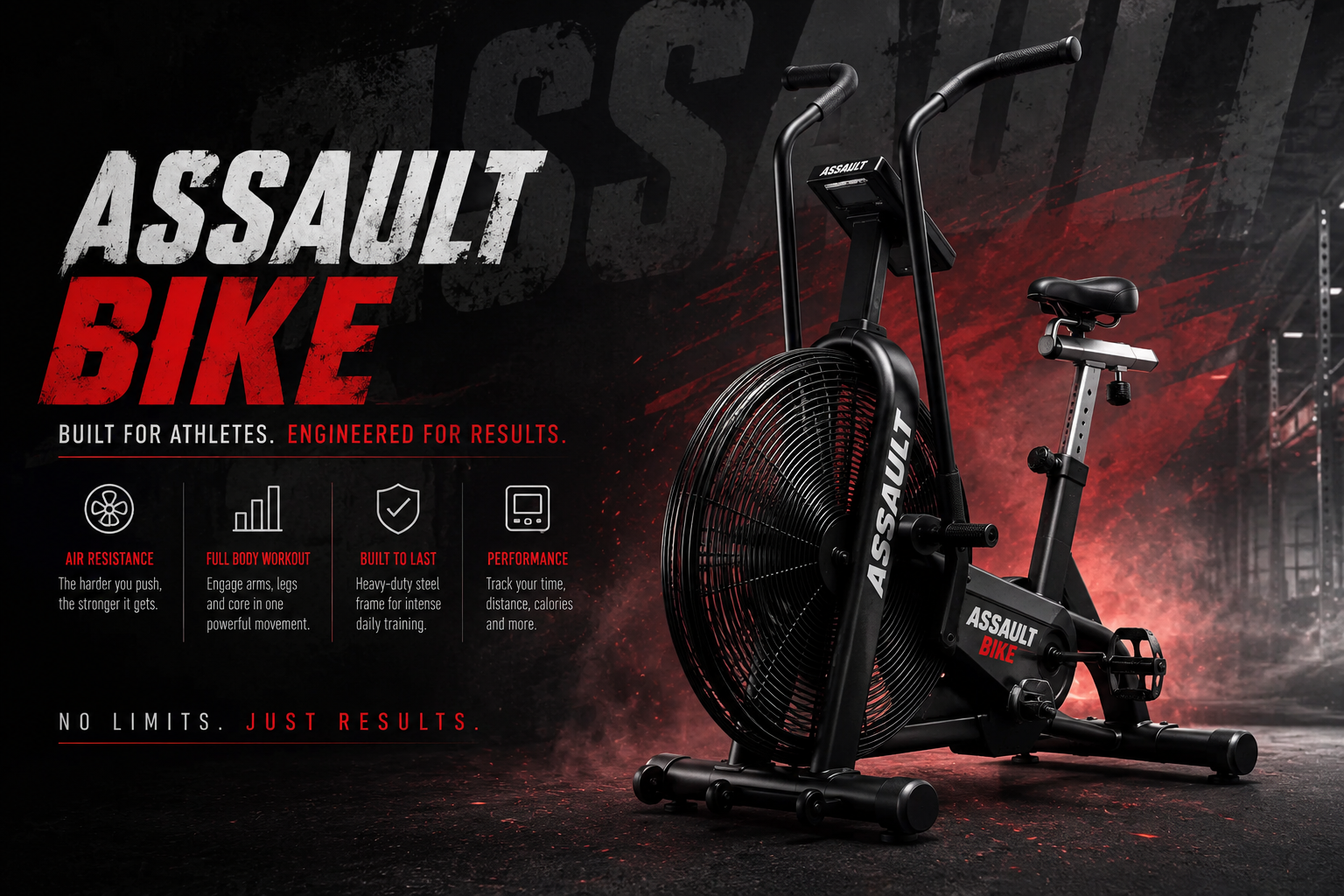
An assault bike, often called an air bike or fan bike, is a stationary exercise bike that uses a large fan wheel to create resistance. Instead of adjusting resistance manually like magnetic exercise bikes, the fan increases resistance naturally as you pedal faster. This means every workout adapts to your effort level.
One of the biggest differences between an assault bike and a regular exercise bike is the addition of moving handlebars. As you push and pull the handles while pedaling, your chest, shoulders, arms, back, core, glutes, and legs all work together. The result is a highly efficient full-body exercise that burns calories quickly while improving cardiovascular fitness.
Professional athletes, CrossFit competitors, military personnel, and everyday gym-goers all rely on assault bikes because they provide scalable workouts. A beginner can pedal comfortably for ten minutes, while an elite athlete can push themselves to complete exhaustion in under a minute. That versatility makes the assault bike suitable for almost every fitness level.
Top Benefits of Using an Assault Bike
One of the greatest advantages of an assault bike is its ability to deliver an intense full-body workout in a relatively short amount of time. Because your upper and lower body work together continuously, your heart rate rises rapidly, helping you burn more calories compared to many traditional cardio machines.
Another significant benefit is low-impact exercise. Unlike running on concrete or using plyometric movements, cycling on an assault bike places minimal stress on your knees, hips, and ankles. This makes it an excellent option for people recovering from injuries or anyone looking for a joint-friendly cardio alternative without sacrificing workout intensity.
The assault bike also excels at improving cardiovascular endurance and muscular stamina. Regular sessions strengthen your heart, improve lung capacity, and enhance overall conditioning. Many athletes incorporate assault bike intervals into their training because they closely mimic the demands of competitive sports, where repeated bursts of high-intensity effort are required.
Beyond physical fitness, assault bike workouts are incredibly time-efficient. Even a 15 to 20-minute interval session can deliver exceptional results. For busy professionals who struggle to find time for exercise, this efficiency is a major advantage that helps maintain consistency.
How to Use an Assault Bike Properly
Using an assault bike correctly begins with proper seat adjustment. The seat should be positioned so that your knee maintains a slight bend when the pedal reaches its lowest point. Riding with an incorrect seat height can lead to discomfort and reduce pedaling efficiency over time.
Proper posture is equally important. Sit upright with relaxed shoulders while maintaining a firm grip on the handlebars. Instead of relying solely on your legs, actively push and pull the handles throughout each pedal stroke. This coordinated movement maximizes muscle engagement and increases calorie expenditure.
Start each workout with a gentle warm-up lasting five to ten minutes. Gradually increase your speed rather than immediately sprinting at maximum effort. After your workout, reduce intensity slowly before stopping completely. Cooling down helps normalize your heart rate and reduces post-workout stiffness.
Breathing should also remain controlled throughout the workout. Many beginners unknowingly hold their breath during intense intervals, which causes fatigue to appear much sooner. Maintaining a steady breathing rhythm allows you to sustain higher levels of performance for longer periods.
Best Assault Bike Workouts for Beginners and Advanced Users
Beginners should focus on developing endurance before attempting high-intensity interval training. A simple routine involves riding for 20 seconds at a comfortable pace followed by 40 seconds of easy pedaling for recovery. Repeating this cycle for 15 to 20 minutes builds confidence while improving cardiovascular fitness without overwhelming the body.
Intermediate users can introduce interval sessions such as 30 seconds of hard effort followed by 30 seconds of recovery. These balanced intervals significantly improve aerobic capacity while teaching the body to recover more efficiently between intense efforts. Performing this workout three times per week produces noticeable improvements in endurance and calorie burn.
Advanced athletes often use assault bikes for sprint intervals. One popular protocol consists of 10 seconds of maximum effort followed by 50 seconds of recovery, repeated for 10 rounds. Another challenging option involves completing as many calories as possible within one minute before resting and repeating multiple rounds. These demanding sessions are excellent for boosting athletic performance and metabolic conditioning.
Long steady-state rides should not be overlooked either. Spending 30 to 45 minutes at a moderate pace develops aerobic endurance while promoting fat utilization. Combining interval sessions with endurance rides creates a balanced training program suitable for nearly any fitness goal.
How to Choose the Best Assault Bike
When shopping for an assault bike, build quality should be your top priority. A sturdy steel frame ensures stability during intense workouts and minimizes unnecessary movement or vibration. High-quality construction also extends the lifespan of the machine, making it a worthwhile long-term investment.
Comfort plays an equally important role. Look for adjustable seat height and horizontal positioning to accommodate different body sizes. Ergonomic handlebars and oversized pedals further improve the riding experience, especially during longer workout sessions.
A clear digital console is another valuable feature. Modern assault bikes typically display calories burned, time, distance, speed, heart rate, RPM, and interval settings. Having access to these metrics makes it easier to track progress and maintain motivation throughout your fitness journey.
Finally, consider maintenance requirements and warranty coverage. Models with sealed bearings, durable fan blades, and corrosion-resistant components require less upkeep over time. A generous manufacturer warranty also provides peace of mind should mechanical issues arise.
Common Mistakes to Avoid
One common mistake is going too hard too soon. Many first-time users attempt all-out sprints immediately, only to become exhausted within seconds. Building endurance gradually allows your cardiovascular system and muscles to adapt safely while reducing injury risk.
Another frequent error is neglecting the upper body. Since the moving handlebars are a defining feature of an assault bike, simply pedaling with minimal arm movement limits the effectiveness of the workout. Driving the handles forcefully engages additional muscle groups and dramatically increases workout intensity.
Poor posture can also reduce efficiency. Leaning excessively forward, hunching your shoulders, or gripping the handlebars too tightly often leads to unnecessary fatigue. Maintaining relaxed but controlled body positioning improves comfort and power output.
Skipping warm-ups and cool-downs is another habit worth avoiding. Proper preparation reduces injury risk, while gradual recovery helps your body transition smoothly after intense exercise.
Is an Assault Bike Worth Buying?
For anyone serious about improving overall fitness, an assault bike is undoubtedly worth considering. Its combination of full-body engagement, scalable resistance, and efficient calorie burning makes it one of the most versatile pieces of home gym equipment available today.
Unlike treadmills or elliptical machines that primarily focus on lower-body movement, an assault bike trains nearly every major muscle group simultaneously. This makes each workout more productive, especially for people who have limited time available for exercise.
The machine is equally valuable for beginners and experienced athletes. Since resistance automatically adjusts based on effort, users never outgrow the equipment. As your fitness improves, the bike naturally becomes more challenging because you’re capable of producing greater power.
Although quality assault bikes often cost more than standard exercise bikes, their durability, versatility, and effectiveness justify the investment for many users. If your goal is to build endurance, burn fat, improve conditioning, and perform efficient workouts at home, few machines offer better overall value.
Frequently Asked Questions (FAQs)
1. Why is it called an assault bike?
The name comes from the extremely demanding nature of its workouts. The bike challenges both your upper and lower body simultaneously, creating an intense cardiovascular and muscular training experience.
2. Is an assault bike good for weight loss?
Yes. Because it engages multiple muscle groups at once and allows high-intensity interval training, an assault bike can burn a significant number of calories, making it highly effective for weight loss when combined with a balanced diet.
3. How long should beginners use an assault bike?
Beginners should start with 10 to 20-minute sessions at a moderate pace and gradually increase duration and intensity as their fitness improves.
4. Does an assault bike build muscle?
While it isn’t a replacement for strength training, it helps develop muscular endurance and strengthens the legs, shoulders, arms, core, and back through continuous resistance.
5. Is an assault bike better than a treadmill?
Both machines have advantages. An assault bike provides a full-body, low-impact workout, while a treadmill mainly targets the lower body and involves greater joint impact. The better choice depends on your fitness goals and physical condition.
6. Can I use an assault bike every day?
Yes, provided you manage workout intensity. Alternating between light recovery rides and high-intensity interval sessions helps prevent overtraining while supporting consistent progress.
Final Thoughts
The assault bike has earned its reputation as one of the most effective cardio machines for a reason. It combines full-body training, unlimited air resistance, low-impact movement, and exceptional calorie-burning potential into a single piece of equipment. Whether you’re aiming to lose weight, improve endurance, increase athletic performance, or simply enjoy efficient workouts, an assault bike adapts to your fitness level and grows with your progress. By learning proper technique, following structured workouts, and avoiding common mistakes, you can maximize your results and make every session count. If you’re looking for a versatile machine that challenges both your body and mind, the assault bike deserves a place at the top of your fitness equipment list.


